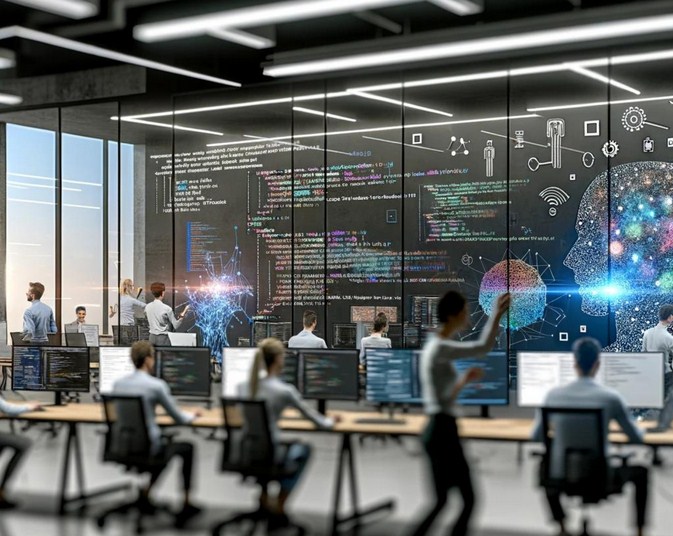
Artificial Intelligence and Machine Learning are revolutionizing custom software development, reshaping design, development, and deployment. This blog explores their transformative role in the industry and how businesses can leverage these technologies to stay ahead of the curve.
Enhancing Development Processes with AI and ML
Streamlining Code Generation
AI and ML algorithms can analyze code repositories, identify patterns, and suggest optimizations, accelerating the coding process. AI tools automate routine tasks, allowing developers to focus on complex aspects and reducing human error.
Predictive Analytics for Better Decision-Making
Predictive analytics, powered by ML, can sift through historical data to forecast trends, user behaviors, and potential system failures before they occur. Integrating these insights into the development process allows teams to make informed decisions, tailor features to user needs, and preemptively address issues, enhancing the software’s reliability and user satisfaction.
Personalized User Experiences
AI and ML are at the forefront of delivering personalized user experiences. By analyzing user interactions, preferences, and feedback, ML algorithms can tailor software behavior and content to individual users. This level of personalization not only improves user engagement but also boosts the software’s value proposition to end-users.
Revolutionizing Software Functionality with AI and ML
Intelligent Automation
AI and ML are revolutionizing software development and management, enabling complex tasks like customer service and inventory management to be automated and executed more efficiently.
Enhanced Data Security
AI and ML play a crucial role in enhancing data security. ML algorithms can continuously learn from network traffic and user behavior to identify and respond to security threats in real-time. By integrating these capabilities, custom software can offer robust security measures that adapt to evolving threats, protecting sensitive data more effectively than ever before.
Predictive Maintenance
In the realm of enterprise applications, predictive maintenance powered by ML can analyze operational data to predict equipment failures or system downtimes before they happen. This proactive approach minimizes disruptions, reduces maintenance costs, and extends the lifespan of critical assets.
Navigating Challenges and Considerations
The integration of AI and ML in software development presents challenges like data quality, privacy, model complexity, and ethical implications. Successful integration requires strategic, transparent, accountable, and continuous learning approaches.
Looking Ahead: The Future of AI and ML in Software Development
Advancements in AI and ML technologies are expected to significantly impact custom software development, enabling smarter applications that automate tasks, reason, learn, and interact human-likely, thereby achieving business objectives.
Conclusion
AI and ML integration in software development is revolutionizing the industry, enabling innovation, efficiency, and personalization. This digital frontier reshapes interaction with technology, unlocking growth and innovation potential.
In navigating this journey, the key to success lies in leveraging AI and ML not just as technologies but as catalysts for reimagining what software can do. The future belongs to those who innovate, and in the realm of custom software development, AI and ML are the beacons leading the way.
#AIDevelopment #MachineLearning #CustomSoftware #PredictiveAnalytics #Personalization #IntelligentAutomation #DataSecurity #SoftwareInnovation #TechTrends #FutureOfDevelopment